Customer Alignment Means Nothing Without the Ability to Evolve
Understanding your customer is only the beginning.
What organizations do with that understanding is what ultimately matters.
Many organizations invest heavily in gathering insight:
- Customer feedback
- Market research
- Employee input
- Operational data
But once the need for change becomes clear, a different challenge emerges:
How do you evolve without creating disruption, confusion, or resistance internally?
Because alignment is not just about identifying what customers need.
It’s about helping the organization move toward those needs together.
Insight Without Change Creates Frustration
One of the fastest ways to erode trust, internally and externally, is to gather insight and fail to act on it effectively.
Customers notice when organizations ask for feedback but don’t evolve.
Employees notice when leadership talks about change without creating clarity around it.
Over time, skepticism grows.
Teams stop believing priorities are real.
Customers stop believing they’re being heard.
Understanding customer truth matters.
But organizations only create impact when that understanding translates into aligned action.
Change Becomes Disruptive When Alignment Is Weak
Most organizations don’t struggle with change because people resist improvement.
They struggle because change often arrives without:
- Clear communication
- Shared understanding
- Consistent leadership direction
- Alignment around why the change matters
That’s when uncertainty spreads.
Teams fill gaps with assumptions.
Departments interpret priorities differently.
Messaging becomes inconsistent internally and externally.
And customers feel the instability almost immediately.
What leaders intended as transformation starts creating friction instead.
Effective Change Requires Internal Alignment First
Organizations often focus externally during periods of change:
- New messaging
- New strategy
- New customer initiatives
- New operational priorities
But external consistency is impossible without internal alignment.
Employees cannot confidently deliver what they do not clearly understand.
That’s why effective change management starts internally:
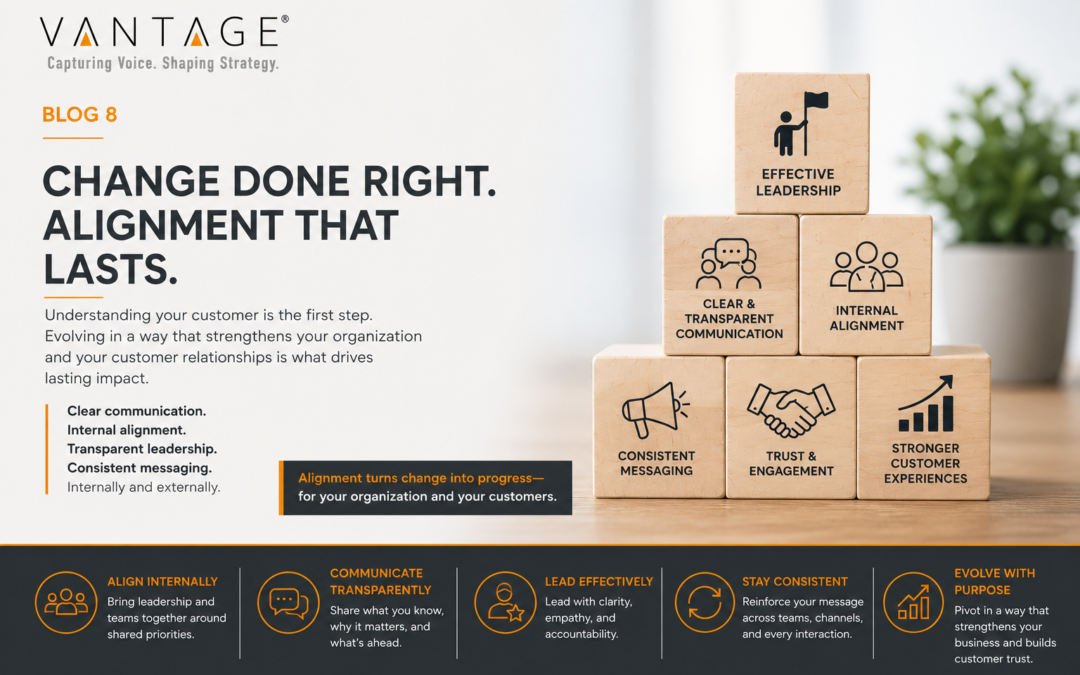
- Leadership teams aligned around the same priorities
- Clear and transparent communication
- Consistent messaging across departments
- Shared understanding of what is changing and why
When internal alignment is strong, organizations move through change with far less disruption.
Not because uncertainty disappears, but because people trust the direction.
Transparency Builds Stability
One of the biggest mistakes organizations make during change is over-controlling communication.
Leaders often wait until every answer is finalized before communicating. In the absence of information, employees begin creating their own narratives.
Transparency creates stability.
Not because leaders know everything.
But because people understand what is happening, what matters most, and how decisions are being made.
That clarity reduces friction.
It allows organizations to pivot without creating unnecessary fear, confusion, or resistance.
Customers Experience Internal Alignment
Customers may never see the internal meetings, planning sessions, or leadership conversations happening behind the scenes.
But they absolutely experience the results of alignment, or the lack of it.
Customers feel:
- Inconsistent messaging
- Conflicting priorities
- Poor handoffs
- Delayed execution
- Reactive decision-making
They also feel when organizations are aligned:
- Clear communication
- Consistent experience
- Confidence in delivery
- Stability during change
A strong customer experience is almost always rooted in strong internal alignment.
Evolution Requires Leadership Discipline
Organizations that evolve well do not simply communicate more.
They communicate consistently.
Leadership matters most during periods of transition because teams look for signals:
- What matters now?
- Has the direction changed?
- Are leaders aligned with each other?
- Can we trust this will hold?
When leadership communication is fragmented, organizations drift.
When leadership communication is aligned, organizations adapt faster, with less disruption and greater trust.
Alignment Allows Organizations to Evolve Without Losing Momentum
The organizations that navigate change most effectively are not the ones avoiding disruption entirely.
They are the ones grounded enough internally to move through change with clarity, consistency, and trust.
That’s what customer alignment creates.
Not rigidity.
Not resistance to change.
But the ability to evolve intentionally, without fragmenting leadership, teams, execution, or customer experience along the way.
Because understanding customer needs is only the first step.
The real challenge is aligning the organization strongly enough to respond.
That’s what it looks like when customer alignment becomes an operating system, one capable of evolving without losing direction.
→ Explore: Customer Alignment as an Operating System
Ready to See Where Alignment Is Holding – and Where It’s Not?
Alignment issues rarely show up all at once.
They show up in patterns.
Take the 60-Second Alignment Gut Check
A fast way to assess how customer alignment is showing up across your strategy, leadership decisions, and execution.
#CustomerAlignment #VoiceoftheCustomer #CustomerExperience #LeadershipAlignment #OperatingModel #StrategicExecution #AlignmentDrift