Customer Alignment Breaks Down When Change Is Done To People, Not With Them
Customer voice work often reveals the truth.
Sometimes that truth is encouraging.
Sometimes it confirms what leaders already suspected.
And sometimes it exposes gaps that require the organization to change.
That is where many organizations struggle.
Not because they do not care about the customer.
Not because they lack strategy.
But because once the gaps are uncovered, they move too quickly from insight to action without first creating alignment around the change required.
They announce the direction.
They explain the decision.
They communicate the plan.
And then they wonder why people are resistant, confused, disengaged, or fatigued.
The problem is not always the change itself.
Often, it is how the change was introduced.
Customer Insight Creates Responsibility
When organizations capture customer voice (internally and/or externally), they create responsibility.
Once you know where customers are experiencing friction, where expectations are shifting, or where your organization is misaligned, you cannot unknow it.
You have to decide what to do next.
That may mean changing priorities.
Shifting roles.
Adjusting processes.
Reallocating resources.
Strengthening leadership communication.
Rebuilding trust internally before you can rebuild consistency externally.
Customer insight is powerful, but it is not passive.
It should move the organization toward action.
But action without internal alignment creates a new problem.
Change Fatigue Is Often an Alignment Problem
Organizations talk a lot about change fatigue.
And it is real.
But sometimes what leaders call change fatigue is actually alignment fatigue.
People are not always tired of change.
They are tired of unclear change.
They are tired of shifting priorities without context.
They are tired of being told what is happening without being invited to understand why it matters.
They are tired of new initiatives that feel disconnected from the work they are already trying to do.
When employees do not understand the purpose behind the change, what is expected of them, or how success will be measured, fatigue builds quickly.
Not because people are unwilling.
Because they are being asked to move without enough clarity.
You Cannot Talk People Into Alignment
One of the biggest mistakes organizations make is assuming communication and alignment are the same thing.
They are not.
Talking at people is not alignment.
Sending an email is not alignment.
Holding one town hall is not alignment.
Alignment requires intentionality.
It requires creating space for people to understand, process, question, and connect the change to the work in front of them.
That does not mean every decision becomes a group decision.
Leadership still has to lead.
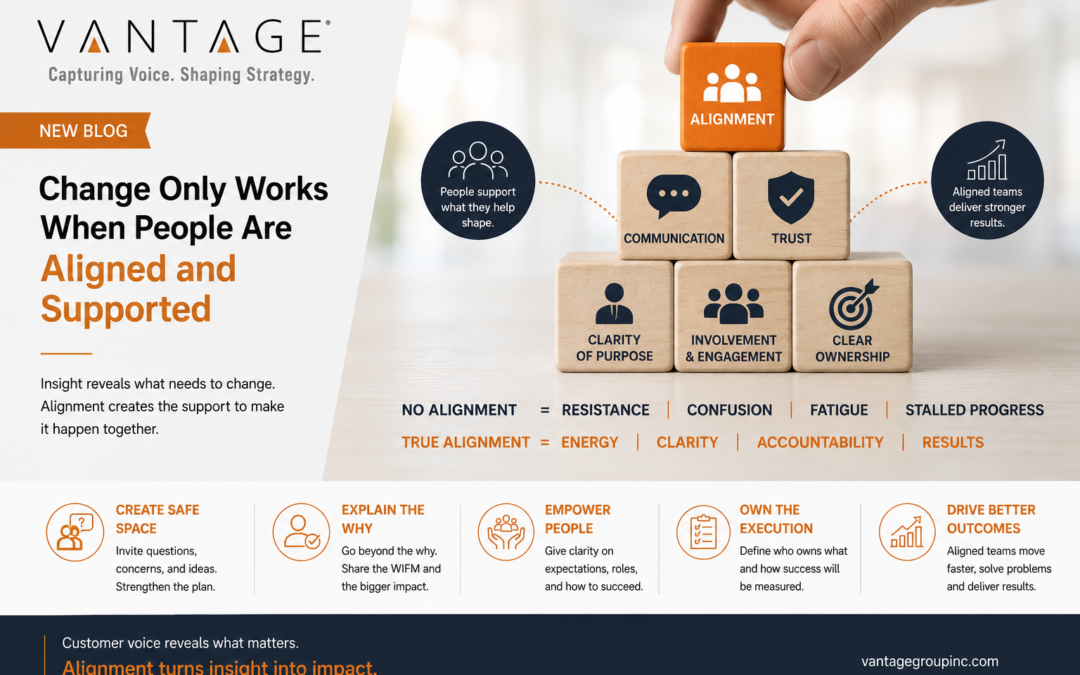
But people support what they understand.
And they are far more likely to engage when they can see the connection between customer needs, business priorities, and their own role in delivering the outcome.
Buy-In Is Built Through Conversation
If leaders want people to support change, they have to give them more than instructions.
They need to create room for dialogue.
That means allowing teams to:
- Ask questions
- Raise concerns
- Challenge assumptions
- Identify risks
- Offer ideas
- Clarify ownership
- Understand what is changing and what is not
Sometimes people need to poke holes in the direction before they can commit to it.
That is not resistance.
That is often engagement.
The goal is not to eliminate disagreement.
The goal is to surface it early enough that it can strengthen the path forward instead of quietly undermining it later.
The “Why” Has to Be More Than a Slogan
Most organizations know they need to explain why change is happening.
But the why cannot stay abstract.
“We need to improve customer experience.”
“We need to become more efficient.”
“We need to grow.”
Those may all be true.
But they are not always enough.
People need to understand the deeper why:
- Why this change matters now
- What customer voice revealed
- What happens if the organization does not respond
- What the change means for their role
- What success looks like
- How the organization benefits
- How customers benefit
- What is in it for the people being asked to change
That last piece matters.
Not because people are selfish.
Because people need to understand how the change connects to meaning, stability, growth, performance, and the future of the organization they are helping build.
Ownership Has to Be Clear
Change breaks down when ownership is vague.
Everyone agrees something needs to happen.
But no one is clear on who owns what.
Or multiple people think they own the same thing.
Or leaders assume teams understand the expectations because the direction was discussed once.
That is where misalignment begins to reappear.
Successful change requires clarity around:
- Who owns the decision
- Who owns the execution
- Who needs to be involved
- Who needs to be informed
- What timeline matters
- What outcomes are expected
- How progress will be measured
Without that clarity, people do their best.
But their best may still move in different directions.
Safe Spaces Create Stronger Execution
Creating a safe space for discussion does not mean lowering standards.
It means creating the conditions for honesty before execution begins.
Leaders need to know:
- Where teams see risk
- Where communication is unclear
- Where capacity is strained
- Where customer needs may be misunderstood
- Where internal processes may prevent success
If people do not feel safe naming those things, leaders are operating with incomplete information.
And incomplete information leads to weaker execution.
The strongest organizations do not avoid hard conversations.
They create the structure to have them early, respectfully, and productively.
Alignment Turns Good Intentions Into Results
Most change efforts begin with good intentions.
Improve the customer experience.
Fix what is not working.
Respond to what was learned.
Strengthen the business.
But good intentions are not enough.
Without alignment, even the right change can create confusion.
Without communication, even the right strategy can feel disruptive.
Without ownership, even the right priority can stall.
Without leadership discipline, even the right insight can fail to translate into action.
Alignment is what turns intention into execution.
And execution is what turns customer voice into measurable impact.
This Is Why Change Management Belongs in the Customer Voice Journey
Customer voice work should not end with insight.
It should lead to aligned action.
That is why change management is not separate from customer alignment.
It is part of it.
At Vantage Group, this is the connection we have been building throughout this series:
Customer voice reveals what matters.
Leadership alignment determines what changes.
Internal communication creates understanding.
Execution turns understanding into results.
And customer experience reflects whether the organization was truly aligned.
This is why we believe customer alignment must function as an operating system.
Not a project.
Not a survey.
Not a leadership conversation that never reaches the people responsible for delivery.
A system that connects insight, strategy, leadership, communication, execution, and customer experience.
Alignment Is What Separates Good Intentions From Excellent Results
Organizations do not become excellent because they care.
Many organizations care.
They become excellent because they create the alignment required to act on what they learn.
- They listen.
- They clarify.
- They communicate.
- They engage their people.
- They define ownership.
- They lead through the discomfort.
- They adjust with intention.
- And they keep customer truth at the center.
When organizations skip alignment, change becomes something people endure.
When organizations build alignment, change becomes something people can help carry.
That is the difference between good intentions and excellent results.
Ready to See Where Alignment Is Holding – and Where It’s Not?
Alignment issues rarely show up all at once.
They show up in patterns.
A fast way to assess how customer alignment is showing up across your strategy, leadership decisions, communication, and execution.
No prep. No data needed. Just your perspective.
#CustomerAlignment #VoiceoftheCustomer #CustomerExperience #LeadershipAlignment #OperatingModel #StrategicExecution #AlignmentDrift