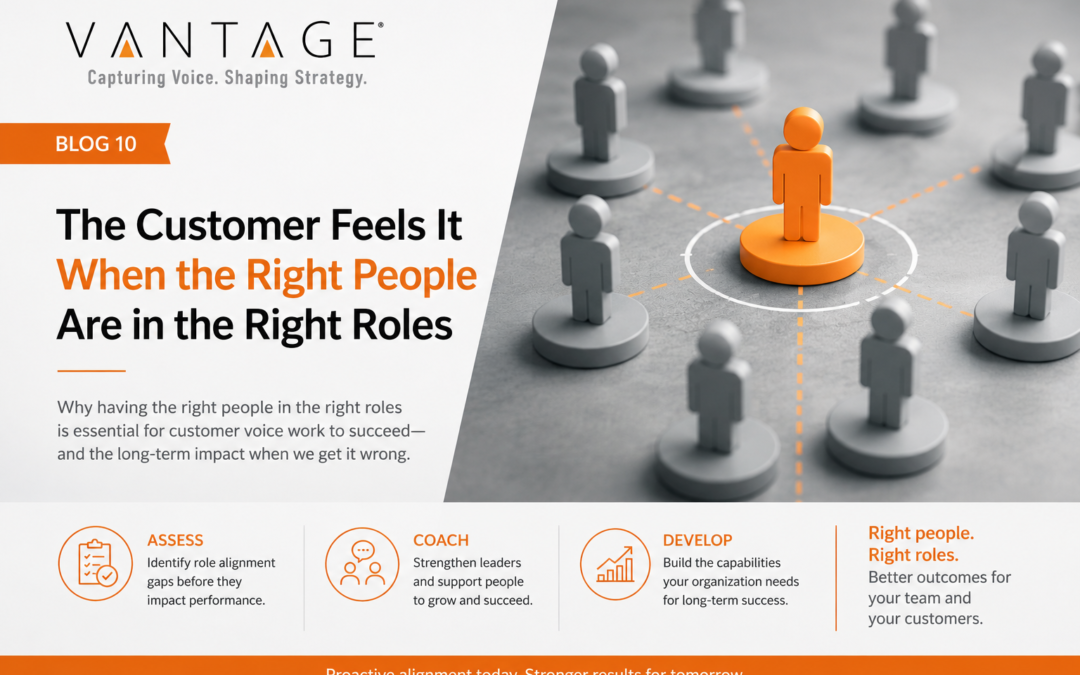
The Customer Feels It When the Right People Are in the Wrong Roles
Customer alignment depends on more than strategy.
It depends on people.
Not just good people.
The right people, in the right roles, doing the right work at the right time.
That distinction matters more than most organizations realize.
Because customer voice work does not succeed long term because an organization collected feedback, held a strategy session, or launched a new initiative.
It succeeds when the people responsible for hearing, interpreting, deciding, communicating, and executing around customer needs are positioned to do that work well.
When they are not, the customer eventually feels it.
And usually, so does everyone inside the organization first.
Good Intentions Can Create Long-Term Friction
Most organizations do not intentionally put the wrong people in critical roles.
More often, it happens for understandable reasons.
Someone has been loyal.
Someone has potential.
Someone has history with the organization.
Someone deserves a chance.
Those things matter.
But they cannot outweigh what the role requires now.
When organizations keep people in roles they are not equipped to succeed in, it may feel supportive in the short term. It may feel like patience, kindness, or loyalty.
But over time, it often creates the opposite effect.
The individual struggles.
The team compensates.
Leaders delay hard decisions.
Customers experience inconsistency.
What began as a well-intended decision becomes a source of friction across the system.
The Internal Cost Shows Up First
When the wrong person is in the wrong seat, teams usually know before leaders are ready to say it.
They feel it in the extra work.
The unclear direction.
The decisions that do not hold.
The accountability that shifts to everyone else.
High performers begin compensating for gaps they did not create.
Managers spend energy managing around the issue instead of addressing it directly.
Teams become frustrated—not because they lack compassion, but because they are carrying the cost of a role that is not working.
This is where culture quietly starts to erode.
Not because one person is failing.
But because the organization is asking everyone else to absorb the impact.
The Customer Experience Eventually Reflects the Role Fit
Customers may never see the internal dynamics behind the scenes.
But they absolutely experience the results.
When people are misaligned to their roles, customer experience often becomes:
- Slower
- Less consistent
- More reactive
- More dependent on individual effort -heroics often come into play
- More vulnerable to hand-off breakdowns
The customer feels the hesitation.
They feel the inconsistency.
They feel when the organization is working around itself instead of operating with clarity.
This is why talent alignment is not just an internal leadership issue.
It is a customer alignment issue.
Because the customer experience is shaped by the people and roles behind every decision, interaction, process, and follow-through.
Customer Voice Work Requires the Right Capabilities
Capturing customer voice is only the beginning.
The harder work is knowing what to do with it.
Organizations need leaders and teams who can:
- Listen without defensiveness
- Interpret customer insight with discipline
- Separate signal from noise
- Make decisions aligned to customer needs
- Communicate clearly across the organization
- Execute consistently over time
That requires capability.
It also requires role clarity.
If the people responsible for customer alignment are not equipped, empowered, or positioned correctly, customer insight can become just another report instead of a driver of action.
This is where customer voice work often stalls.
Not because the insight is weak.
Because the organization does not have the right people in the right seats to carry it forward.
Prolonging the Inevitable Is Never the Right Choice
One of the hardest leadership decisions is admitting when a role fit is not working.
It can feel personal. It can feel uncomfortable. It can feel easier to wait.
But prolonging the inevitable rarely protects people.
It usually extends frustration.
For the individual, it delays clarity.
For the team, it deepens resentment.
For the customer, it creates inconsistency.
For the organization, it slows performance.
Leadership requires the courage to name what is true.
Sometimes that means investing in development.
Sometimes it means coaching someone into stronger performance.
Sometimes it means redesigning a role.
And sometimes it means making a change.
The key is to act with both clarity and care.
Avoiding the decision is not kindness when everyone is paying the cost.
Alignment Requires a Short-, Mid-, and Long-Term Talent View
The strongest organizations do not wait until role misalignment becomes painful.
They assess it proactively.
In the short term, that may mean identifying immediate friction points:
- Where is customer experience breaking down?
- Where are teams compensating?
- Where is execution slowing because ownership is unclear?
In the mid term, it may mean coaching and development:
- Which leaders need support to grow into what the role now requires?
- What capabilities need to be strengthened?
- Where does communication, decision-making, or accountability need reinforcement?
In the long term, it means strategic talent alignment:
- Do we have the right leaders for where we are going?
- Are roles designed around current and future customer needs?
- Are talent decisions supporting strategy, or preserving legacy structure?
This is where assessments, coaching, leadership development, and strategic planning become powerful. Not as separate initiatives. As tools to support alignment.
The Right People in the Right Seats Protect the Customer Experience
Customer alignment cannot be sustained by messaging alone.
It has to be carried by people who are positioned to deliver it.
When the right people are in the right roles:
- Decisions get clearer
- Teams move with more confidence
- Accountability strengthens
- Customer needs stay visible
- Execution becomes more consistent
When they are not, alignment becomes fragile.
The organization may still talk about customer needs.
But the experience will not hold.
Because customers do not experience your intentions.
They experience your execution.
And execution depends on role fit, capability, leadership, and accountability.
Alignment Is a People Discipline, Too
It is easy to think about customer alignment as strategy work.
And it is.
But it is also leadership work.
Talent work.
Communication work.
Development work.
If organizations want customer voice to shape strategy long term, they have to ensure the people responsible for carrying that work forward are equipped and aligned to do so.
That means being honest about capability.
It means supporting people where growth is possible.
It means making difficult decisions when the fit is not right.
And it means recognizing that the cost of inaction is rarely contained internally.
The customer feels it. The team feels it. The business feels it.
Right people, right seats is not a slogan.
It is a requirement for customer alignment that holds.
This is what it looks like when customer alignment becomes an operating system, one supported by the people, roles, and capabilities required to deliver on customer needs consistently.
→ Explore customer alignment as an operating system
Ready to See Where Alignment Is Holding – and Where It’s Not?
Alignment issues rarely show up all at once.
They show up in patterns.
Take the 60-second Alignment Gut Check
A fast way to assess how customer alignment is showing up across your strategy, leadership decisions, talent, and execution.No prep. No data needed. Just your perspective.
#CustomerAlignment #VoiceoftheCustomer #CustomerExperience #LeadershipAlignment #OperatingModel #StrategicExecution #AlignmentDrift