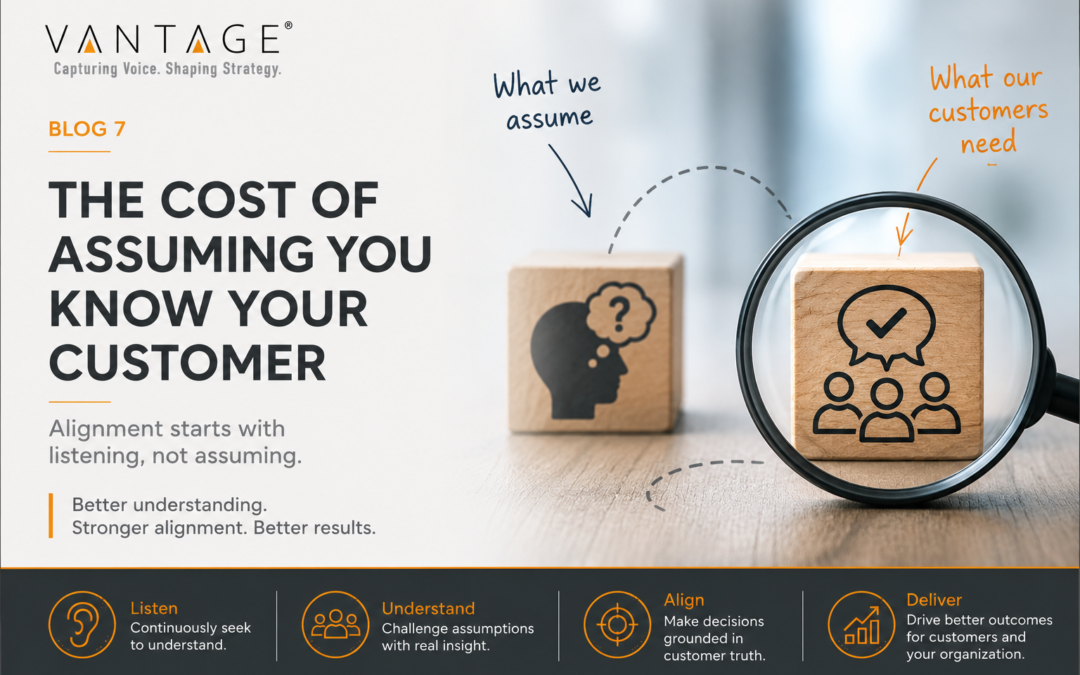
The Cost of Assuming You Know Your Customer
One of the most common alignment problems organizations face starts with a simple assumption:
We already know what our customers need.
Sometimes that assumption is based on history.
Sometimes on instinct.
Sometimes on leadership confidence or past success.
And sometimes, it’s simply because organizations stop listening once they believe they have enough information.
That’s where alignment starts to drift.
Not because organizations stop caring about customers, but because they begin operating from assumptions instead of understanding.
Assumption Creates Blind Spots
Most organizations don’t intentionally ignore customer needs.
What happens instead is more subtle.
Leaders begin relying on internal perspective as a substitute for external reality. Teams make decisions based on what they believe customers value, rather than what customers are actually experiencing.
Over time, those assumptions compound.
Products evolve around internal priorities.
Processes become organization-centered instead of customer-centered.
Decisions reinforce what’s familiar instead of what’s needed.
And eventually, organizations become highly aligned internally around the wrong things.
That’s the danger of assumption.
Internal agreement can create the illusion of alignment, even while customer expectations are shifting outside the organization.
Listening Is Not a One-Time Exercise
Customer understanding is not static.
Markets shift.
Expectations evolve.
Needs change.
Pressure points move.
Organizations that stop listening eventually start reacting.
They wonder why engagement drops.
Why loyalty weakens.
Why execution feels disconnected from results.
Often, the issue isn’t capability.
It’s outdated understanding.
Customer alignment requires ongoing discipline, not occasional feedback collection.
Listening has to become operational.
Customer Truth Requires Humility
One of the biggest barriers to alignment is certainty.
Organizations often move quickly to solutions before fully understanding the problem. Leaders assume they already know what matters most because they’ve seen similar situations before.
But customer truth requires humility.
It requires organizations to test assumptions instead of defend them.
The strongest organizations don’t assume they know.
They stay curious long enough to understand.
That curiosity creates better questions:
- What are customers actually experiencing?
- Where are we creating friction without realizing it?
- What assumptions are shaping our decisions right now?
- Are internal priorities aligned to external reality?
Those questions create clarity.
And clarity creates alignment.
Alignment Happens When Understanding Is Shared
Customer insight only creates value when it changes how decisions are made.
Too often, customer information sits in reports, surveys, dashboards, or isolated conversations. Teams gather insight, but leadership decisions continue operating from assumption.
Alignment strengthens when customer understanding becomes shared understanding.
When leaders, teams, and functions are grounded in the same reality:
- Decisions reinforce each other
- Priorities become clearer
- Execution becomes more consistent
- Customer experience improves naturally
That’s when organizations stop reacting to symptoms and start addressing root causes.
Assumption Slows Organizations Down
Ironically, assumption often feels faster in the moment.
Listening takes time.
Understanding takes discipline.
Alignment requires conversation.
But organizations built on assumption spend far more time compensating later:
- Reworking decisions
- Correcting course
- Managing confusion
- Repairing customer trust
- Realigning teams after the fact
Assumption creates friction that organizations eventually have to absorb somewhere.
Alignment reduces that friction by grounding decisions in reality from the beginning.
Alignment Starts with Listening
Organizations don’t create alignment by becoming louder internally.
They create alignment by listening more clearly—externally and internally—and allowing that understanding to shape strategy, leadership decisions, and execution.
Because customer alignment doesn’t happen through assumption.
It happens through disciplined understanding.
And the organizations willing to keep listening are the ones most capable of moving forward with clarity, consistency, and trust.
That’s what it looks like when customer alignment becomes an operating system, grounded in understanding instead of assumption.
→ Explore: Customer Alignment as an Operating System
Ready to See Where Alignment Is Holding – and Where It’s Not?
Alignment issues rarely show up all at once.
They show up in patterns.
Take the 60-Second Alignment Gut Check
A fast way to assess how customer alignment is showing up across your strategy, leadership decisions, and execution.
#CustomerAlignment #VoiceoftheCustomer #CustomerExperience #LeadershipAlignment #OperatingModel #StrategicExecution #AlignmentDrift