Alignment Is Not Control: Why Great Organizations Push Decisions Closer to the Work
One of the misconceptions I think we have about organizational alignment is that when everyone is truly aligned, leadership has greater control over what happens throughout the organization. Every decision follows the strategy, everyone stays on the same page, and when something important comes up, leadership weighs in to make sure the right decision gets made.
I actually think good alignment should create almost the opposite.
When an organization is truly aligned, fewer decisions should need to make their way all the way to the top. People throughout the organization should understand where the business is going, what matters most, what they’re trying to accomplish for the customer, and how their work contributes to those outcomes. They should understand the priorities and the guardrails well enough to make good decisions in their own spaces.
That doesn’t diminish the role of leadership. It demonstrates that leadership has done its job well.
Recent McKinsey research examining what successful owner-CEOs get right reinforced this idea. One of the practices highlighted is pushing appropriate decision-making toward people closer to serving customer needs while still maintaining clear accountability.
That caught my attention because I see the opposite happen in organizations all the time. Someone closest to the work sees a problem or an opportunity, but they don’t feel they have the authority to do anything about it. So the issue moves to a manager, who takes it to another manager, who eventually takes it into a leadership meeting. By the time a decision works its way back to the person who first saw the issue, a lot of time has passed, and sometimes a lot of context has been lost along the way.
There are absolutely decisions that belong at the executive level. But there are also a lot of decisions being made at the executive level simply because the organization hasn’t created enough clarity for people to confidently make them anywhere else.
Explore More: Alignment Doesn’t Mean Leadership Makes Every Decision
How Organizational Alignment Creates Clarity to Act
We talk a lot about empowerment in organizations, but I don’t think empowerment works without alignment.
Telling people they’re empowered to make decisions sounds great. But if I don’t understand the strategy, if priorities aren’t clear, if I’m getting competing messages from different leaders, or if I don’t know what outcome we’re actually trying to create, what exactly am I empowered to do?
I’m left interpreting.
And if ten people are interpreting the strategy ten different ways, we’ve created autonomy, but we haven’t created alignment.
When alignment is strong, people have context. They understand not only what we’re trying to accomplish but why it matters. They understand what we’re prioritizing, what trade-offs we’re willing to make, what success should look like, and where the boundaries of their authority are. That gives people something much more useful than permission. It gives them the information they need to exercise good judgment.
We saw this play out with a client that was experiencing a significant amount of operational friction. Problems that could have been identified much earlier were making their way too far into execution. By the time someone addressed them, they had become considerably harder, more expensive, and more disruptive to solve.
The answer could have been more oversight. More approvals. More decisions moving upward.
Instead, the organization began working on greater clarity closer to the work. Expectations became clearer, responsibilities were reconsidered, and people were given greater accountability for recognizing and escalating concerns earlier. Rather than redesigning everything at once, the organization tested a different approach through a pilot and gave the people doing the work room to execute within it.
But there was another part of that pilot that I think is just as important as the empowerment itself.
They kept checking back in.
Why Feedback Loops Matter to Strategy Execution
Giving people clarity and authority to act doesn’t mean leadership sets the strategy, sends everyone off to execute it, and waits six months to see what happened.
That’s not alignment either.
I’ve always thought about strategy less like a waterfall and more like a fountain.
We often talk about strategy “cascading” through an organization. Leadership sets the direction, it moves through the organization, teams translate it into plans, and eventually it reaches execution.
But a cascade only moves one way. Organizations need information moving in both directions.
Once people begin executing a strategy, they start learning things that leadership couldn’t possibly have known when the strategy was developed. Customers react. Employees encounter friction. Assumptions get tested. A process works differently in practice than it did on paper. Something that seemed incredibly important during planning turns out to matter less than expected. Something nobody anticipated suddenly matters a lot.
That’s where the fountain comes in.
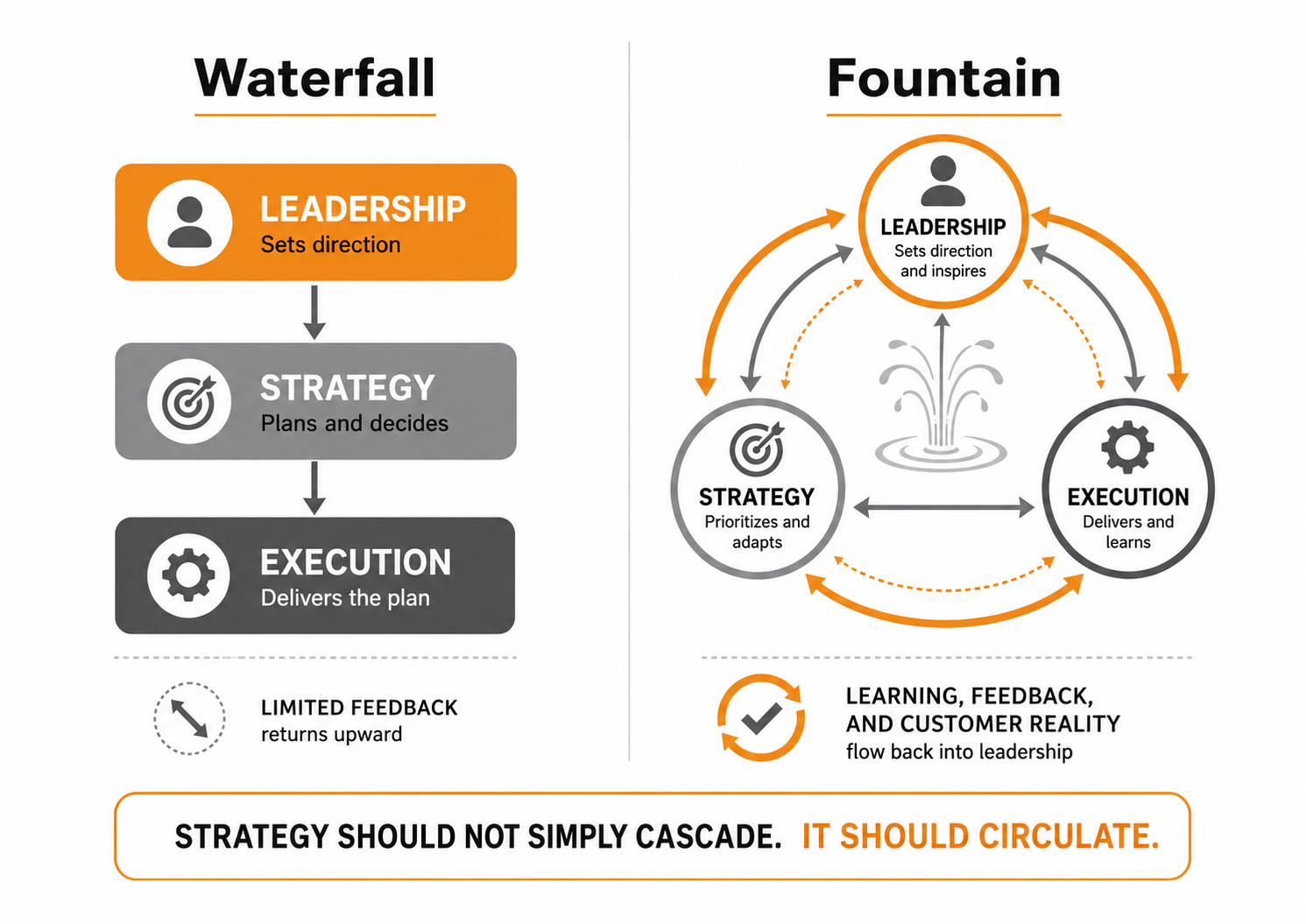
Direction flows outward into the organization, but information needs to continually flow back. We need opportunities to ask what we’re learning, what customers are experiencing, what employees closest to the work are seeing, whether our assumptions are holding, and whether the actions we’re taking are actually producing the results we intended.
Then we can decide whether something needs to change. Sometimes the answer is no. The strategy is right, the early indicators are right, and we need to stay the course. Sometimes the answer is that execution needs to adjust. And sometimes what we’re learning tells us that one of the assumptions underneath the strategy itself needs to be reconsidered.
The important thing is that we find out while we’re moving, not after we’ve spent six months executing beautifully in the wrong direction.
Strategy Shouldn’t Just Cascade. It Should Circulate.
Effective strategy execution requires information to move in both directions. Leadership provides direction, but what employees and customers teach us through execution has to find its way back into leadership decisions.
That’s why I think feedback loops are such an important part of organizational alignment.
Feedback isn’t just something we collect from customers or employees. It’s how an organization checks itself against reality.
Are we still aligned around the same outcome? Is what we believed when we made the decision still true? Are our internal actions creating the external experience we intended? Are the people closest to execution seeing something leadership needs to know?
Those conversations don’t require us to constantly change strategy. In fact, sometimes the feedback gives us greater confidence that we should keep going. Continuous adaptation doesn’t mean continuous reaction. It means we’ve created deliberate points along the way to check the signal before we get too far down the implementation path. That’s a very different way of thinking about strategy execution.
Instead of thinking only in terms of: Decide → Cascade → Execute → Measure
we begin thinking more like: Align → Act → Listen → Learn → Realign → Begin Again
The organization is still moving forward. We’re simply checking our direction as we go.
Explore More: VANTAGE POINT OF VIEW Strategy Shouldn’t Just Cascade. It Should Circulate.
What Does Organizational Alignment Actually Look Like?
Organizational alignment doesn’t mean agreement on every decision, and it doesn’t mean dependence on leadership for every answer.
At Vantage, we think about alignment as the connection between Leadership, Strategy, and Execution around a shared understanding of customer reality.
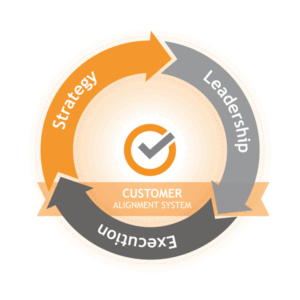
When those elements are working together, people understand where the organization is going, why it matters, what outcomes they’re responsible for creating, and how their decisions contribute to the larger strategy.
Just as importantly, information continues moving in the other direction.
What employees learn through execution matters. What customers experience matters. What the market is telling us matters. Those signals need a path back into the leadership system so assumptions can be challenged, results can be evaluated, and strategy can adjust when reality tells us it needs to.
That’s what allows an organization to operate with both clarity and adaptability.
And it’s why we believe internal and external customer voices have to work together. The external customer can often tell us where something isn’t working. The internal customer can often help us understand why.
When those voices are connected to Leadership, Strategy, and Execution, they become much more than feedback.
They become part of how the organization learns.
How Feedback Loops Help Prevent Alignment Drift™
Alignment Drift™ usually doesn’t happen because someone suddenly decides to ignore the strategy. It’s much more subtle than that.
One team encounters something unexpected and adjusts. Another team interprets a priority slightly differently. A customer behavior changes. An assumption that was true six months ago becomes less true. A short-term pressure causes a reasonable decision that moves the organization a little further away from the original intent.
Any one of those things may be perfectly understandable.
The problem comes when nobody reconnects them.
Over time, Leadership, Strategy, and Execution can begin moving apart even though everyone believes they’re still working toward the same thing. Feedback loops give us opportunities to catch that separation while it’s still small.
They allow us to ask whether we’re still seeing the customer outcomes we intended, whether our assumptions are holding, whether employees are encountering barriers we didn’t anticipate, and whether execution is revealing something leadership needs to understand.
We don’t have to wait for the annual strategic planning session, or a disappointing performance measure, to discover the organization has been moving away from reality.
We can catch the signal earlier. Listen. Learn. Check our direction. Realign when necessary. Keep moving.
Questions Worth Asking
- How many decisions are making their way to senior leadership simply because people don’t have enough clarity to confidently make them elsewhere?
- And on the other side, how easily can something learned by the people closest to your customers or the work make its way back into a leadership decision?
Those two directions of travel can tell you a lot about the health of your organizational alignment.
Frequently Asked Questions
What is organizational alignment?
Organizational alignment exists when leadership, strategy, and execution are connected around a shared understanding of where the organization is going, what matters, and the outcomes it is trying to create. Strong alignment also includes feedback loops that allow new information from employees, customers, and execution to influence future decisions.
Does organizational alignment require centralized decision-making?
No. Strong organizational alignment can actually enable more decentralized decision-making because employees understand the strategy, priorities, desired outcomes, and guardrails well enough to make appropriate decisions closer to the work. Leadership retains responsibility for the decisions that belong at its level without becoming the bottleneck for every decision throughout the organization.
Why are feedback loops important to organizational alignment?
Feedback loops allow information from execution, employees, and customers to travel back into leadership decisions. They help organizations test assumptions, evaluate whether actions are producing the intended results, and make adjustments before small gaps become Alignment Drift™.
Explore More:
Your Customer Doesn’t Experience Your Org Chart
When Customer Signals Don’t Reach Leadership
Customer Alignment as an Operating System
You can’t Improve what you Don’t Measure: Why Alignment Needs a Signal
#CustomerAlignment #VoiceoftheCustomer #CustomerExperience #LeadershipAlignment #OperatingModel #StrategicExecution #AlignmentDrift