You Can’t Improve What You Don’t Measure: Why Alignment Needs a Signal
Most organizations measure performance.
Far fewer measure alignment. And yet, alignment is often the hidden variable influencing everything else:
- Decision-making
- Execution speed
- Leadership consistency
- Employee trust
- Customer experience
- Organizational performance
When alignment weakens, organizations feel it long before they can clearly define it.
Leaders sense friction.
Teams feel confusion.
Execution slows.
Priorities compete.
But without a way to measure alignment directly, organizations often react to symptoms instead of identifying the source.
That’s where drift begins.
Alignment Is Often Assumed, Not Assessed
One of the most common leadership assumptions is this:
“We’re aligned because we’ve talked about the strategy.”
But communication alone does not create alignment.
Alignment shows up in:
- How decisions are made
- How priorities hold under pressure
- How consistently leaders reinforce direction
- How clearly teams understand what matters most
- How quickly organizations adapt to customer reality
And many organizations discover those things are far less consistent than they believed.
That’s why alignment needs a signal.
Not just instinct.
Not just perception.
Something measurable.
Misalignment Usually Hides in Plain Sight
Organizations rarely become misaligned overnight.
It happens gradually:
- Teams interpret priorities differently
- Customer insight doesn’t consistently shape decisions
- Leadership messaging becomes uneven
- Execution absorbs the cost of unclear direction
- Departments optimize for themselves instead of the organization as a whole
At first, organizations compensate.
More meetings.
More clarification.
More reactive communication.
But eventually the friction becomes operational.
Without visibility into alignment health, leaders are often solving downstream problems while the real issue remains untouched.
A Healthy Organization Has a Shared Signal
Strong organizations operate from a shared signal.
Customer truth informs strategy.
Leadership reinforces consistent priorities.
Execution aligns around what matters most.
When that signal weakens, organizations become reactive:
- Decisions slow down
- Teams lose confidence
- Customer experience becomes inconsistent
- Trust erodes internally
The challenge is that most organizations do not have a structured way to identify where alignment is holding, and where it’s slipping.
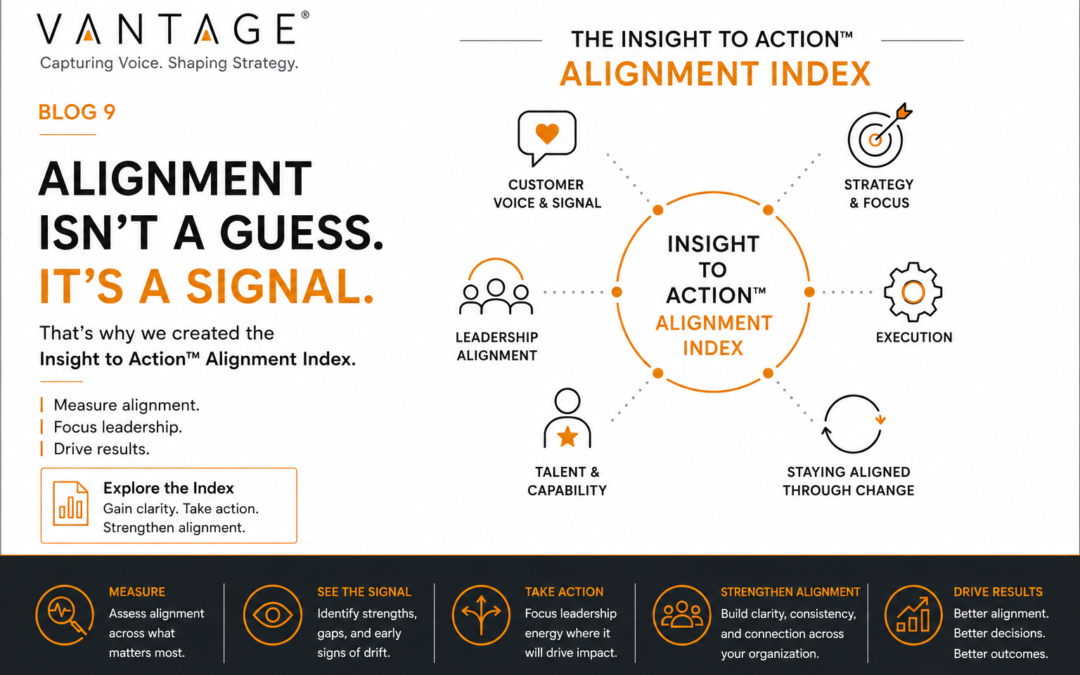
That’s why we developed the Alignment Health Signal™.
Insight-to-Action™ Alignment Index
The Insight to Action™ Alignment Index Health Signal is designed to help organizations assess how alignment is functioning across six critical areas:
- Customer Voice & Signal
- Strategy & Focus
- Leadership Alignment
- Execution
- Talent & Capability
- Staying Aligned Through Change
Because alignment is not one thing.
It’s the connection between strategy, leadership behavior, execution, communication, and customer reality.
The index helps organizations identify:
- Where alignment is strong
- Where drift is beginning
- Where friction is becoming operational
- And where leadership attention is needed most
Not through assumption.
Through signal.
Alignment Is a Leadership Discipline
One of the biggest misconceptions about alignment is that it’s cultural by nature.
In reality, alignment is operational.
It can be observed.
Measured.
Strengthened.
Managed intentionally.
Organizations with strong alignment are not lucky.
They create:
- Clear priorities
- Consistent leadership messaging
- Transparent communication
- Shared understanding of customer needs
- Disciplined decision-making systems
That discipline creates stability, even during growth and change.
Strong Organizations Monitor Alignment Before It Breaks
Most organizations wait until friction becomes painful before addressing alignment:
- Declining execution
- Customer dissatisfaction
- Leadership frustration
- Retention issues
- Conflicting priorities
But by then, misalignment has already become expensive.
The strongest organizations treat alignment proactively.
They monitor it early.
Pressure-test it consistently.
And recalibrate before drift becomes dysfunction.
Because alignment does not sustain itself automatically.
It requires attention.
Alignment Should Never Be a Guess
Organizations measure financial performance because it matters.
They measure customer satisfaction because it matters.
They measure operational performance because it matters.
Alignment matters just as much.
Because when alignment weakens, everything else becomes harder to sustain.
That’s why organizations need more than strategy.
They need visibility into whether strategy, leadership, and execution are actually moving together.
That’s the role of the Alignment Index Health Signal, helping organizations identify alignment strength before misalignment becomes operational friction.
→ Explore the Alignment Index Health Signal
#CustomerAlignment #VoiceoftheCustomer #CustomerExperience #LeadershipAlignment #OperatingModel #StrategicExecution #AlignmentDrift