Right Person, Right Seat…Or Just Different Than You?
One of the most common leadership challenges I encounter as a coach is helping leaders distinguish between two very different realities:
Is this the wrong person for the role?
Or
Is this simply someone who approaches the work differently than I would?
Those are not the same thing.
Yet they get confused all the time.
Especially in organizations led by high-performing, highly driven leaders.
High Performers Often Create an Unintentional Standard
Many leaders reach their positions because they are exceptional performers.
They move quickly. They solve problems aggressively. They push for results. They hold high standards.
Those are often the very characteristics that helped them succeed.
The challenge comes when they begin evaluating others.
Because consciously or unconsciously, they start measuring people against themselves.
- “That’s not how I would have handled it.”
- “I would have moved faster.”
- “I would have approached that differently.”
- “I would have communicated more directly.”
Maybe.
But that’s not necessarily the standard.
The standard is whether the role is producing the outcomes the organization needs.
There Are a Lot of Ways to Get Things Done
There is an old saying:
“There are a lot of ways to make the sausage.”
I’ve never loved the phrase…But the point is valid.
There are countless ways to achieve a result.
Some leaders are highly analytical. Others are highly relational. Some drive through urgency. Others build consensus.
Some leaders are direct and decisive. Others are thoughtful and collaborative.
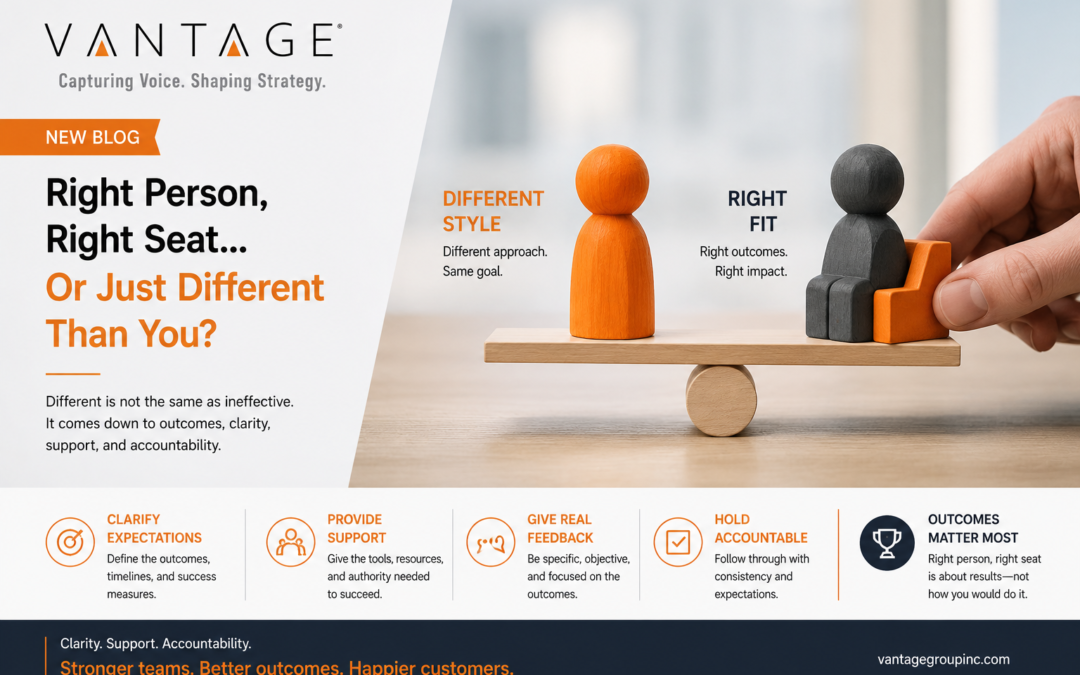
Different does not automatically mean ineffective.
In fact, some of the strongest leadership teams intentionally combine different approaches because diversity of thought creates stronger decisions.
The goal is not to create a team full of people who lead exactly like you.
The goal is to create a team that consistently delivers the outcomes the organization requires.
The Real Question Is: What Does Success Look Like?
When leaders become frustrated, I often ask a simple question:
Have you clearly defined success?
Not generally…Specifically.
- What exactly does this role need to accomplish?
- What outcomes are expected?
- What timeline matters?
- What business needs must be met?
- What customer expectations must be delivered?
Because if those things aren’t clear, leaders often default to evaluating style instead of performance.
And style is subjective. Outcomes are not.
Clarity and Accountability Go Hand in Hand
One of the biggest mistakes organizations make is holding people accountable for expectations that were never fully clarified.
Accountability starts with clarity.
Have we clearly communicated:
- What success looks like?
- What outcomes must be achieved?
- What timelines matter?
- What priorities matter most?
- How this role contributes to the customer experience and business objectives?
If those things are not clear, frustration often becomes a substitute for leadership.
And frustration rarely solves anything.
Have We Given Them What They Need to Succeed?
Before leaders determine someone is the wrong fit, another important question needs to be answered:
Have we provided the support required for success?
That includes:
- Clear expectations
- Training
- Resources
- Coaching
- Feedback
- Tools
- Decision-making authority
Sometimes performance issues are not capability issues.
They’re support issues.
Organizations often underestimate how much clarity, development, and coaching influence outcomes.
Before making conclusions about fit, leaders should honestly assess whether they have done their part as well.
Feedback Is Not the Same as Frustration
This is where many leaders struggle.
They feel frustration, but they haven’t provided feedback. At least not feedback that is specific enough to create change.
Comments like:
- “You need to be more proactive.”
- “You need to step up.”
- “You need to think more strategically.”
Rarely help.
People need objective feedback.
Specific examples. Clear observations. Concrete expectations.
- What’s working.
- What’s not working.
- What needs to change.
- What success looks like moving forward.
That isn’t harsh. It’s leadership. And it’s one of the most respectful things we can provide another person.
Focus on the What Before Judging the How
One of the most valuable shifts leaders can make is learning to separate outcomes from preferences.
Many leadership frustrations are actually disagreements about process.
The person achieved the outcome.
They simply didn’t achieve it the way you would have.
That distinction matters.
If the outcome is being delivered:
- The customer is being served.
- The business need is being met.
- The team is performing.
- The expectations are being achieved.
Then the conversation may be less about capability and more about leadership flexibility.
Not every successful leader will look like you.
Nor should they.
When It Really Is a Fit Issue
At some point, however, leadership requires honesty.
If expectations have been clear…
If support has been provided…
If coaching has been offered…
If objective feedback has been given…
And the required outcomes are still not being achieved…
Then the issue is no longer about style.
It is about performance and role fit.
That doesn’t make someone a bad employee.
Or a bad leader.
It simply means the gap between what the role requires and what the individual is delivering has become too large.
At that point, leaders owe people clarity.
Not endless ambiguity. Not indefinite waiting. Not moving goalposts.
Clarity.
The Goal Is Fairness, Not Comfort
One of the reasons these decisions become so difficult is because leaders often want certainty.
They want to know beyond any doubt that they’re making the right decision.
Unfortunately, leadership rarely works that way.
What leaders can do is create a process that is fair.
Clear expectations. Appropriate support. Honest feedback. Objective measurement. Consistent accountability.
When those things are present, decisions become more straightforward.
Not easy. But honest. And importantly, they don’t come as a surprise.
Customers Feel the Difference
Like so many topics in this series, this conversation ultimately connects back to customer alignment.
Customers don’t care whether internal leaders agree on management styles.
They care about outcomes.
They experience:
- Responsiveness
- Consistency
- Accountability
- Communication
- Execution
Those outcomes are influenced by leadership quality, role fit, and organizational clarity.
When leaders confuse personal preference with performance expectations, organizations create unnecessary friction.
When leaders focus on outcomes, support, accountability, and clarity, organizations create stronger teams and stronger customer experiences.
Right Person, Right Seat Requires More Than Instinct
The best leaders don’t simply ask:
“Would I do it this way?”
They ask:
“Have we clearly defined success?”
“Have we provided the support needed?”
“Have we given objective feedback?”
“Are the outcomes being achieved?”
Because right person, right seat isn’t ultimately about whether someone works like you.
It’s about whether they can consistently deliver what the role, the organization, and the customer require.
And when leaders can make that distinction, talent decisions become far more effective—and far more fair.
Ready to Strengthen Leadership Alignment?
The strongest organizations create clarity before they create accountability.
Whether through coaching, leadership development, assessments, or organizational alignment work, helping leaders distinguish between preference and performance is one of the most important capabilities an organization can build.
→ Explore Leadership Development & Alignment Solutions
#CustomerAlignment #VoiceoftheCustomer #CustomerExperience #LeadershipAlignment #OperatingModel #StrategicExecution #AlignmentDrift