Confidence Is Powerful. Curiosity Keeps It Honest.
Leadership demands confidence.
Every day, leaders are asked to make decisions with incomplete information. Teams are waiting for direction. Customers are waiting for answers. Markets continue moving whether we’re ready or not.
The job of a leader isn’t to know everything before acting.
- It’s to think.
- To trust experience.
- To exercise judgment.
- To move the organization forward.
Thinking isn’t the problem.
Confidence isn’t the problem.
In fact, they’re two of a leader’s greatest assets.
The real question is this:
How do you keep confidence from becoming certainty?
Because there’s a fine line between trusting your instincts and assuming you already know.
Experience Should Expand Your Thinking…Not Narrow It
One of the greatest gifts experience gives us is instinct.
The longer we lead, the more patterns we recognize. We begin connecting dots faster. We anticipate challenges before they happen and we learn from both our successes and our failures.
That’s wisdom. But experience has a quiet trap. Sometimes the more we’ve seen, the less curious we become. We start finishing people’s sentences. We assume we know what customers are going to say before we ask, and often believe we already understand what our teams are experiencing. We stop investigating because we’ve convinced ourselves we’ve already figured it out.
And that’s where leaders begin to drift. Not because they’re incapable. Not because they’re careless.
Because they stop challenging whether what they believe is still true.
“I Think…”
Have you ever caught yourself saying:
- “I think our customers are happy.”
- “I think everyone understands the strategy.”
- “I think communication has gotten better.”
- “I think we’re aligned.”
I’ve said those things.
You’ve probably said them too.
Sometimes they’re true. Sometimes they aren’t.
The phrase “I think” isn’t dangerous. Thinking is exactly what leaders are called to do.
The danger is what comes next. Do we stay curious enough to verify our thinking? Or do we allow our thinking to quietly become fact?
That’s where leadership maturity begins to separate itself. The strongest leaders don’t stop thinking. They simply develop the discipline to challenge their own thinking.
Progress Doesn’t Require Finality
This is something I remind leaders of often.
Progress doesn’t require certainty.
Too often we believe every decision has to be perfect before we move. Other times, we move so quickly that we mistake momentum for understanding.
Neither creates alignment. Progress simply means we’re moving forward.Sometimes we fail forward. Sometimes we exceed expectations. Most often, we’re somewhere in between.
That’s leadership. The goal isn’t to eliminate uncertainty. The goal is to make the best decision you can with the information you have today, while remaining humble enough to adjust when tomorrow teaches you something new.
That’s not indecision. That’s disciplined judgment.
Alignment Drift Begins With Assumptions
Organizations rarely become misaligned because someone makes one terrible decision.
They drift.
One assumption at a time.
- “I think everyone knows where we’re headed.”
- “I think Operations understands Sales.”
- “I think our customers value this most.”
- “I think communication is working.”
None of those assumptions feel dangerous by themselves. But together, they slowly create different versions of reality inside the same organization.
Departments begin solving different problems. Processes evolve in different directions. Leaders unintentionally reinforce competing priorities. People become frustrated. Trust begins to erode.
Not because people don’t care. Because they’re no longer operating from the same understanding.
Eventually, customers experience that fragmentation too.
A fragmented internal experience almost always creates a fragmented external experience.
That’s alignment drift.
Confidence Needs Accountability
This is why I believe confidence should never operate alone.
It needs accountability. Not accountability in the traditional performance management sense. Accountability to reality.
Every leader needs people, processes, and disciplines that challenge their thinking before assumptions become strategy.
Some of the strongest leaders I’ve worked with ask themselves questions like:
- What do I know?
- What do I believe?
- What am I assuming?
- What evidence supports that?
- Who sees this differently than I do?
- What might I be missing?
Those questions don’t weaken confidence.
They strengthen it.
Because confidence built on curiosity is far more resilient than confidence built on assumption.
Capturing Voice Keeps Strategy Honest
At Vantage Group, this belief has fundamentally shaped how we’ve evolved our work.
We don’t begin with recommendations. We begin with understanding. Because before you shape strategy, you have to understand reality.
- That means listening to customers.
- Listening to employees.
- Listening to leaders.
Sometimes all three tell different stories. And that’s exactly where alignment begins.
We believe strategy should be challenged by reality, not protected from it.
That’s why our philosophy is simple:
Capturing Voice. Shaping Strategy.
Because strategy built on assumptions creates drift. Strategy built on understanding creates alignment.
One Final Thought
I’ve never met a great leader who stopped learning.
The longer they’ve led, the more intentional they’ve become about testing their own thinking. They trust their instincts. But they don’t worship them.
They move with urgency. But they leave room to learn.
They make decisions. But they understand that progress doesn’t require finality. It requires humility.
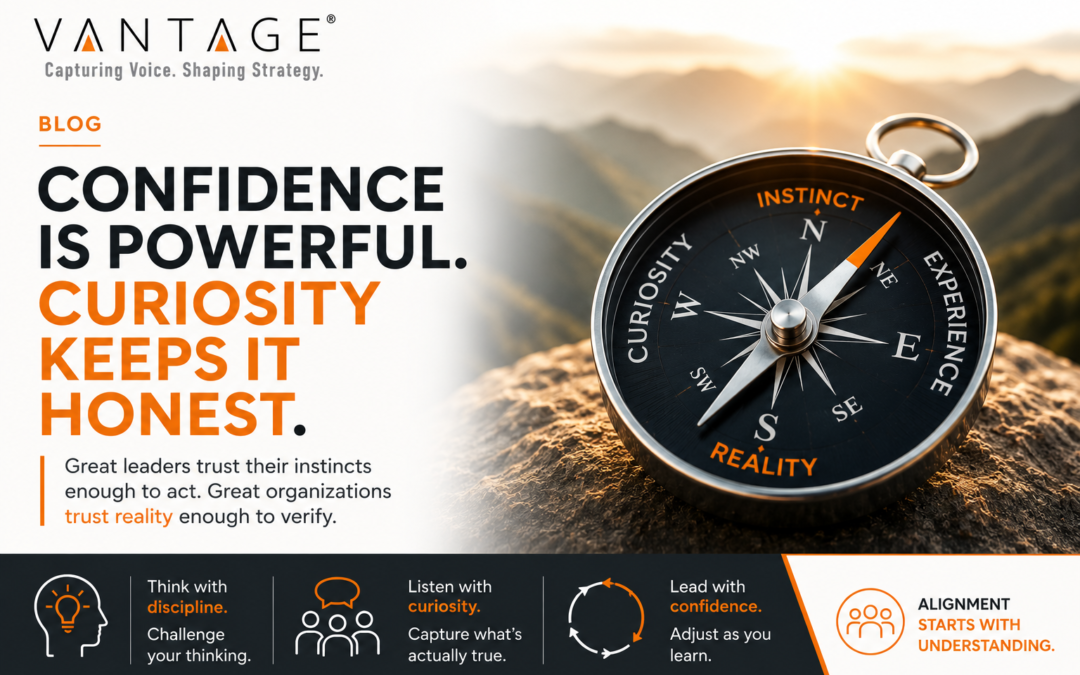
The best leaders know that confidence and curiosity aren’t competing ideas. They’re partners. One gives us the courage to move. The other gives us the wisdom to keep learning. Because confidence is powerful.
Curiosity is what keeps it honest.
This Is Why Customer Alignment Matters
This is exactly why we believe customer alignment is an operating system – not an initiative.
It creates a disciplined way for organizations to continually reconnect strategy, leadership, and execution to reality. It ensures decisions remain grounded, teams stay aligned, and organizations continue learning as they grow.
The organizations that stay aligned aren’t the ones with the smartest leaders.
They’re the ones that never stop challenging what they think they know.
Ready to see where assumptions may be creating alignment drift in your organization?
Take the 60-Second Alignment Gut Check
A quick assessment to evaluate how customer alignment is showing up across your strategy, leadership decisions, and execution.
#CustomerAlignment #VoiceoftheCustomer #CustomerExperience #LeadershipAlignment #OperatingModel #StrategicExecution #AlignmentDrift