
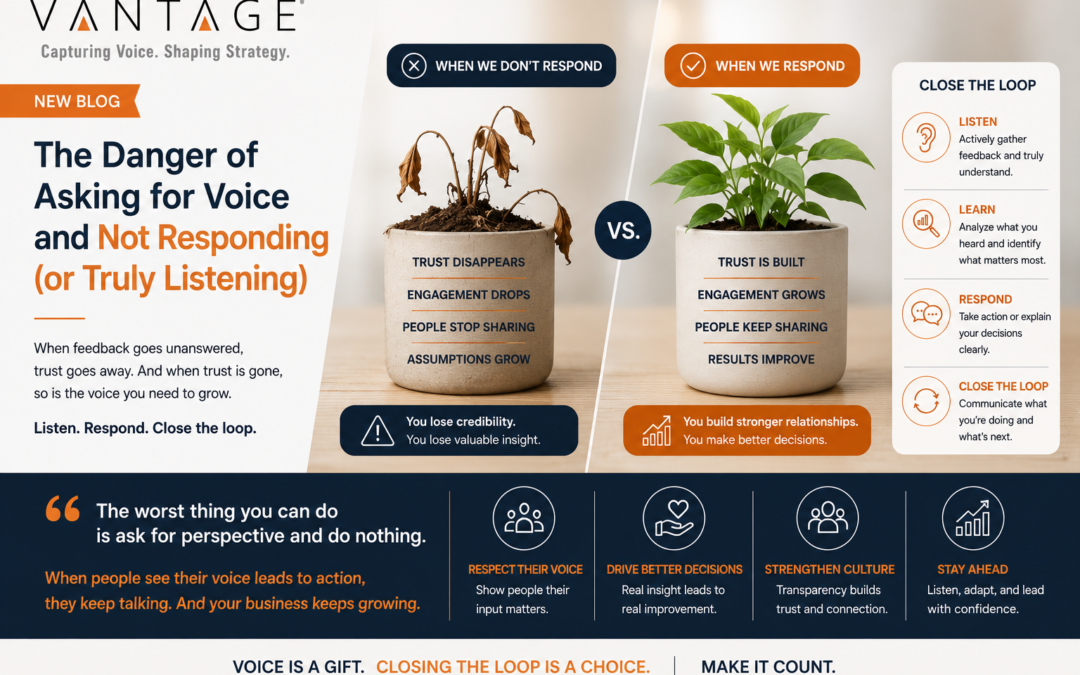
The Fastest Way to Lose Trust? Ask for Feedback and Do Nothing With It.
Most organizations believe asking for feedback is a sign that they care.
And it is.
Until nothing happens afterward. Then it becomes a sign of something else.
A lack of listening. A lack of follow-through. A lack of trust.
Throughout this series, we’ve talked extensively about the importance of customer voice, leadership alignment, execution, change management, and customer truth.
But there is a critical step that often gets overlooked:
Closing the loop.
Because gathering feedback is not the goal.
Using it is.
And if organizations are not prepared to listen, respond, and communicate what happens next, they may be doing more harm than good.
Asking Is Easy. Listening Is Hard.
Most organizations have no problem collecting feedback.
Employee surveys. Customer surveys. Focus groups. Interviews. Advisory councils. Listening sessions. Suggestion boxes. Pulse surveys.
The challenge is rarely getting feedback.
The challenge is what happens after it arrives.
Too often, organizations ask people for their perspective and then:
- Never acknowledge what they heard.
- Never communicate what was learned.
- Never explain what actions will be taken.
- Never explain why certain suggestions will not be implemented.
People are left wondering:
“Did anyone actually read this?”
“Why did you ask if nothing was going to happen?”
“What’s the point of speaking up?”
That is where trust begins to erode.
Silence Creates More Damage Than You Think
Many leaders assume that gathering feedback creates goodwill.
In reality, gathering feedback creates expectations.
The moment you ask someone for their perspective, they assume it matters.
And it should.
That doesn’t mean every suggestion gets implemented.
It doesn’t mean every concern changes the direction of the business.
But it does mean people deserve to know their input was heard.
When organizations remain silent after collecting feedback, people begin drawing their own conclusions.
And those conclusions are rarely positive.
Employees assume leadership doesn’t care.
Customers assume their concerns don’t matter.
Teams assume decisions were already made before feedback was gathered.
Over time, participation drops.
Engagement drops.
Trust drops.
And eventually, people stop talking.
The Most Dangerous Outcome Is Not Negative Feedback
Many leaders worry about receiving difficult feedback.
They shouldn’t.
Difficult feedback is valuable. It reveals opportunities and blind spots.
It helps organizations improve.
The truly dangerous outcome is something else.
Silence. When employees stop speaking up, customers stop telling you what’s wrong, concerns go unspoken, ideas stay hidden, and frustration turns into disengagement.
At that point, the organization hasn’t solved the problem. It has simply lost visibility into it.
And that’s a dangerous place to operate.
People Will Eventually Stop Talking
We’ve seen this repeatedly with internal employee surveys.
- An organization conducts a survey.
- Employees take the time to provide honest feedback.
- The results come back.
- Then nothing happens.
Or perhaps something does happen, but nobody communicates it.
- Nobody closes the loop.
- Nobody explains what was learned.
- Nobody explains what actions are being taken.
- The next time the survey comes around, participation declines.
The time after that, responses become less candid. Eventually, employees stop investing in the process altogether. Not because they don’t care. Because they’ve learned their input doesn’t lead anywhere.
The same thing happens externally with customers.
If customers repeatedly provide feedback and never see evidence that it matters, they eventually stop sharing it.
And when that happens, organizations lose one of their most valuable competitive advantages.
Listening Is More Than Collection
Many organizations mistake collection for listening.
They are not the same thing.
Collection is gathering information.
Listening is demonstrating understanding.
The difference is visible in what happens next.
Listening requires organizations to:
- Analyze the feedback.
- Identify themes.
- Prioritize opportunities.
- Make decisions.
- Communicate outcomes.
- Take action.
Without those steps, feedback becomes a transaction instead of a relationship.
Not Every Suggestion Needs to Become Action
One of the biggest misconceptions about customer voice work is that organizations must implement every recommendation.
That is neither realistic nor desirable.
Sometimes feedback reveals competing needs.
Sometimes suggestions conflict with strategy.
Sometimes the organization has better alternatives.
That is okay.
The goal is not to do everything people ask.
The goal is to demonstrate that their input was genuinely considered.
People are remarkably understanding when leaders communicate openly.
What frustrates people is not hearing “no.”
What frustrates people is hearing nothing.
The Power of Explaining Why
One of the simplest ways to build trust is to explain your thinking.
- Here’s what we heard.
- Here’s what we’re doing.
- Here’s what we’re not doing.
- And here’s why.
That level of transparency changes everything.
It shows respect. It demonstrates listening .It helps people understand the bigger picture. And it reinforces that feedback is part of decision-making rather than a performative exercise.
Sometimes the answer to feedback is action. Sometimes it’s education. Sometimes it’s a better alternative.
All three can strengthen trust when communicated effectively.
Closing the Loop Is Where Trust Is Built
Customer voice work doesn’t end when the survey closes.
It doesn’t end when the interviews are complete.
It doesn’t end when the report is delivered.
It ends when people understand what happened because they spoke up.
That is the moment trust is reinforced.
That is the moment participation becomes worthwhile.
That is the moment people become willing to engage again.
Closing the loop is not a courtesy.
It is the mechanism that makes customer voice work sustainable.
This Is Why Customer Alignment Requires Action
Throughout this blog series, we’ve explored the progression from customer voice to customer alignment.
Voice alone is not enough.
Insight alone is not enough.
Even strategy alone is not enough.
Organizations create value when they move from:
Voice → Insight → Alignment → Action → Communication
Miss one of those steps and the process begins to break down.
The most common failure point?
Action and communication.
Organizations hear the feedback but never demonstrate what happened because of it.
And that is where credibility begins to disappear.
Assumptions Thrive Where Feedback Dies
When people stop talking, leaders don’t stop making decisions.
They simply start making them with less information.
More assumptions. More guesswork. More blind spots. And less confidence that they’re solving the right problems.
That’s why failing to close the loop is so dangerous.
Not because feedback was wasted.
Because future feedback may never come.
The organization slowly loses access to the perspectives it needs to stay relevant, improve performance, and serve customers effectively.
Customer Voice Is a Commitment
Customer voice work is not a survey.
It is not a project.
It is not a one-time initiative.
It is a commitment.
- A commitment to listen.
- A commitment to learn.
- A commitment to respond.
- And a commitment to communicate what happens next.
At Vantage Group, we believe capturing voice is only the beginning.
The real value comes from shaping strategy around what you’ve learned and ensuring people can see how their feedback contributed to the path forward.
Because when people believe their voice matters, they continue sharing it.
When they believe it doesn’t, they stop.
And once the conversation stops, organizations are left guessing.
That’s a risky way to lead.
And an even riskier way to compete.
Ready to Turn Feedback Into Action?
The organizations that create lasting alignment aren’t the ones that ask the most questions.
They’re the ones that consistently close the loop.
Because customer voice only creates value when people can see that it matters.
→ Explore Customer Alignment & Voice Solutions
#CustomerAlignment #VoiceoftheCustomer #CustomerExperience #LeadershipAlignment #OperatingModel #StrategicExecution #AlignmentDrift