The Customers You Lose Are Usually the Ones You Thought You’d Keep
Few customer relationships end overnight.
Most begin fading long before anyone notices.
There isn’t one dramatic phone call.
There isn’t one catastrophic mistake.
There isn’t one competitor who suddenly swoops in and steals your business.
Instead…
- The relationship slowly loses relevance.
- Communication becomes less frequent.
- Conversations become more transactional.
- Assumptions replace curiosity.
And before you know it, the customer you’ve worked with for years is evaluating other options.
Not because they were looking to leave.
Because someone else was paying closer attention.
Success Can Become Your Greatest Blind Spot
One of the greatest risks successful organizations face is comfort.
The relationship feels secure.
The customer has been with you for years.
You know their business. You know their people. You know how they like things done.
Or at least…You think you do.
Success often convinces us that yesterday’s understanding is sufficient for tomorrow’s customer.
It isn’t.
Your Customers Continue to Evolve
One of the biggest misconceptions organizations make is believing customer needs remain relatively stable.
They don’t.
Businesses evolve.
Markets change. Technology advances. Leadership changes. New priorities emerge. Budgets shift. Risk tolerance changes. Decision-making structures evolve. The person who championed your partnership may now lead another division…Or another company. The executive who trusted you may have retired. The new leader may be asking entirely different questions.
Meanwhile…
You may still be selling to the organization you knew three years ago.
The Competition Never Stops Listening
While you’re assuming…
Someone else is asking questions.
While you’re relying on history…
Someone else is building relationships.
While you’re feeling comfortable…
Someone else is learning where your customer is frustrated.
One of the greatest myths in business is that customers leave because of price.
Often…
They leave because someone else demonstrated a better understanding of where they’re trying to go.
The competitor didn’t necessarily have the better product.
They had the more current understanding.
Listening Is More Important Than Changing
Here’s something that surprises many leaders.
Listening doesn’t always lead to change.
Sometimes your customer confirms you’re doing exactly the right things.
That’s valuable.
Sometimes they tell you your service remains exceptional.
That’s valuable too.
Customer voice isn’t about constantly reinventing your business.
It’s about ensuring you’re still solving the problems your customer actually has.
The goal isn’t endless change.
The goal is continued relevance.
Relationships Need Maintenance
We often think of customer relationships like contracts.
Sign the agreement. Deliver consistently. Renew.
In reality…
Relationships behave much more like partnerships.
They require attention.
Conversation. Curiosity. Honesty.
They require leaders willing to ask:
- “What has changed?”
- “What are you working toward now?”
- “What frustrations are emerging?”
- “How can we create more value than we did last year?”
Organizations that continue asking those questions rarely get surprised.
Assumptions Are Expensive
Throughout this series we’ve written about one dangerous leadership habit.
Assuming.
- Assuming we know what employees think.
- Assuming leaders are aligned.
- Assuming customers are happy.
- Assuming everyone understands the strategy.
- Assuming relationships are secure.
Assumptions feel efficient. Listening feels slower.
Until the assumption proves wrong.
Then the cost becomes obvious.
Customer Loyalty Is Earned Again and Again
One of the greatest misconceptions in business is believing loyalty is permanent.
It isn’t.
Every interaction either reinforces trust…Or slowly weakens it.
Every conversation either deepens understanding…Or allows distance to grow.
The strongest organizations don’t earn loyalty once. They continually earn it.
This Is Why Customer Alignment Never Ends
This is one of the biggest reasons we’ve evolved our work beyond traditional Voice of the Customer projects.
Customer alignment isn’t something you complete. It’s something you maintain.
It’s a system.
- One that continually captures both internal and external voice.
- One that helps leadership recognize changing priorities before they become customer problems.
- One that keeps strategy connected to reality.
- One that ensures execution evolves alongside customer expectations.
Because customer alignment isn’t about reacting faster. It’s about trying to not fall behind.
Customers Leave Long Before They Leave
One of the hardest truths for leaders to accept is this:
Customers often disengage long before they terminate the relationship.
Communication changes. Engagement changes. Energy and trust changes.
By the time the contract is at risk…
The relationship has usually been drifting for quite some time.
The organizations that recognize those signals early have an opportunity.
The organizations that don’t…well…they often find themselves fighting to save relationships they thought were secure.
Listening Is Your Competitive Advantage
When organizations stop listening, they stop learning.
When they stop learning, they stop evolving.
When they stop evolving, competitors begin closing the gap.
At Vantage Group, we believe customer voice is not about protecting today’s business.
It’s about earning tomorrow’s.
Because your competitors are paying attention.
The question is…
Are you?
Ready to Stay Aligned With the Customers You Can’t Afford to Lose?
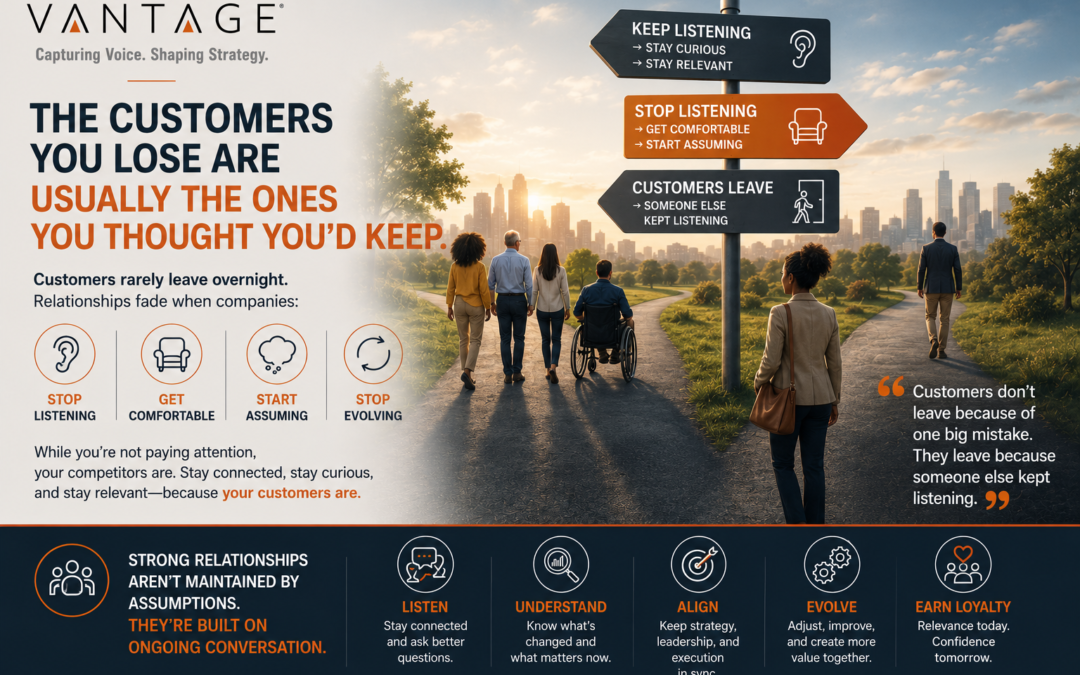
The strongest customer relationships aren’t built on assumptions. They’re built on ongoing conversation.
Our Customer Alignment System helps organizations continuously capture customer voice, align leadership, shape strategy, and execute with confidence, before valuable relationships begin to drift.
Because customers don’t usually leave because of one big mistake. They leave because someone else kept listening.
#CustomerAlignment #VoiceoftheCustomer #CustomerExperience #LeadershipAlignment #OperatingModel #StrategicExecution #AlignmentDrift